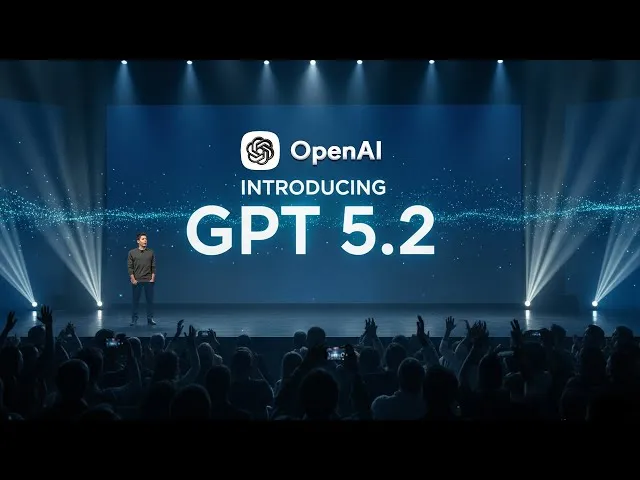
OpenAI is pushing out GPT-5.2 ahead of schedule, and while the update isn’t wrapped in the usual blockbuster marketing, it arrives at a moment when competitive pressure is rewriting the entire frontier-model landscape. Gemini 3 reset expectations. Claude 4.5 Opus closed gaps in reasoning. Benchmarks that once separated OpenAI from the pack suddenly feel like open territory again.
GPT-5.2, however, is not a flashy answer—it’s a strategic one.
A recalibration of priorities.
A statement that speed, stability, and real-world reliability now matter more than any leaderboard.
And that’s exactly why this release is happening now.
Why OpenAI Is Releasing GPT-5.2 Now
GPT-5.2 is less a victory lap and more a tactical maneuver. According to people familiar with OpenAI’s roadmap, the company faced growing internal pressure to respond to a rapidly shifting competitive environment—one defined not by parameter counts but by practical, observable improvements.
Three forces pushed OpenAI to accelerate:
1. Competitors started outperforming GPT-5.1 where it mattered
Gemini 3 and Claude 4.5 both delivered tangible advantages:
-
faster reasoning
-
lower latency
-
higher consistency in multi-step tasks
-
stronger performance on new benchmarks simulating real-world decisions
In internal tests, both models outscored GPT-5.1 in categories users feel immediately—especially in long-context planning and tool-dependent workflows.
2. Users became increasingly sensitive to instability
Enterprises and high-volume API customers reported a visible rise in:
-
inconsistent step-by-step reasoning
-
higher hallucination rates during long-chain tasks
-
mid-conversation forgetfulness
-
delays under peak load
These issues weren’t catastrophic, but they were persistent—and noticeable.
3. OpenAI needed to signal control of the narrative
After a year of industry-defining releases, OpenAI suddenly found itself reacting instead of leading. GPT-5.2 is not the model meant to reclaim the crown—but it is meant to close critical gaps in reliability and daily usability.
In short, GPT-5.2 exists because the market demanded steadiness, not spectacle.
What New Features and Improvements Will GPT-5.2 Bring?
Despite being framed as a performance-first release, GPT-5.2 does introduce a handful of improvements that will be clearly noticeable:
1. Faster reasoning and lower latency
Internal optimizations mean GPT-5.2 responds more decisively, especially during long-chain or tool-assisted reasoning.
2. Fewer hallucinations
A new reasoning evaluation method—GDPval—guides training and alignment, helping the model avoid confident-but-wrong answers.
3. Better long-context handling
GPT-5.2 maintains conversational coherence across thousands of tokens with fewer regressions and fewer incorrect callbacks to earlier context.
4. Stronger multimodal grounding
Visual reasoning is less brittle. The model misinterprets fewer spatial or logical relationships inside an image.
5. More stable at scale
OpenAI hardened GPT-5.2 around high-concurrency use, reducing timeout errors and degraded performance during peak hours.
This is the kind of update users may not immediately admire, but they will absolutely feel.
How GPT-5.2 Affects Everyday Users
For typical ChatGPT users, GPT-5.2 won’t feel like a dramatic leap—because its biggest changes target the invisible infrastructure of intelligence.
The daily experience, however, becomes smoother:
1. Faster replies even when servers are busy
GPT-5.2 maintains lower latency better than GPT-5.1 under load.
2. Fewer moments where the model “loses the thread.”
Long conversations stay coherent longer.
3. Better recall of earlier messages
Context drift is noticeably reduced.
4. Less downtime from server-switching
GPT-5.2 supports improved hot-swapping on infrastructure, meaning fewer disruptions.
If long-term memory-search features roll out broadly, GPT-5.2 may feel even more like a personalized assistant.
What GPT-5.2 Means for Developers and Businesses
For API users, GPT-5.2 may have a larger impact than for casual chat users.
Expected benefits include:
- Drop-in API compatibility, requiring no major code changes
- Faster processing for large documents and complex prompts
- Improved stability in production environments
- Potentially lower compute cost per request due to efficiency gains
Reports also suggest that internal architectural optimizations focused on throughput and cost-effectiveness have positioned GPT-5.2 as one of OpenAI’s most practical models for real-world deployment.
GPT-5.2 vs Gemini 3: Where the Differences Show
Instead of a simple narrative comparison, here’s a clearer breakdown of how GPT-5.2 and Gemini 3 differ in strategy, performance, and real-world behavior:
| Category | GPT-5.2 | Gemini 3 |
|---|---|---|
| Overall Strategy | Prioritizes reliability, stability, and predictable reasoning across long tasks | Prioritizes speed of iteration, multimodal expansion, and leaderboard wins |
| Performance Philosophy | Conservative, grounded, lower hallucination rate | Aggressive improvements, higher variance across tasks |
| Reasoning Consistency | Stronger step-by-step logic, fewer reasoning resets | High peak performance but less consistent across long chains |
| Latency & Responsiveness | Faster under load due to optimized pipelines | Faster in ideal conditions but more variable in heavy workflows |
| Multimodal Strength | Solid and stable; fewer visual misinterpretations | More ambitious multimodal demos, broader visual capabilities |
| Long-Context Handling | More coherent over long dialogues, fewer memory drops | Strong but occasionally inconsistent over extended sessions |
| Enterprise Stability | Built for predictable throughput and reduced failure rates | Built for rapid feature expansion rather than ultra-stable production |
| Benchmark Performance | Highly competitive in reasoning-heavy tests (GDPval, ARC-AGI, GPQA) | Stronger in multimodal tests and multilingual evaluations |
| Release Cadence | Deliberate, stability-first | Rapid, expansion-first |
| Who It’s Best For | Developers needing reliability; enterprises scaling production workloads | Users prioritizing cutting-edge multimodal features and fast iteration |
In short:
Gemini 3 pushes boundaries; GPT-5.2 reinforces foundations.
The two models increasingly represent different philosophies—not direct replacements for each other.
Community and Media Reactions
Reactions so far share a common theme: GPT-5.2 is not glamorous, but it’s important.
Media outlets
Describe GPT-5.2 as a “course correction” and a “performance stabilizer” rather than a groundbreaking release.
Developers
Praise increases in:
-
reliability
-
step-by-step consistency
-
reduced hallucinations
-
throughput on heavy workloads
Users
Still compare multimodal demos with Gemini, but acknowledge GPT-5.2 “feels more grounded.”
The consensus: GPT-5.2 is OpenAI saying, “We heard you.”
Is GPT-5.2 a Big Deal?
Yes—just not in the traditional sense.
GPT-5.2 doesn’t redefine AI.
It doesn’t promise AGI.
It doesn’t shift paradigms overnight.
But it does something increasingly rare:
It makes AI more trustworthy.
In a year defined by rapid jumps and competitive chaos, reliability is finally becoming a feature—and GPT-5.2 leans into that philosophy fully.
For users:
a smoother, more stable experience.
For developers:
a dependable model with lower operational friction.
For the industry:
a clear sign that the AI race isn’t just about who moves fastest—
but who moves most consistently?
GPT-5.2 is OpenAI’s reminder that leadership isn’t always loud.
Sometimes, it’s a quiet return to fundamentals.