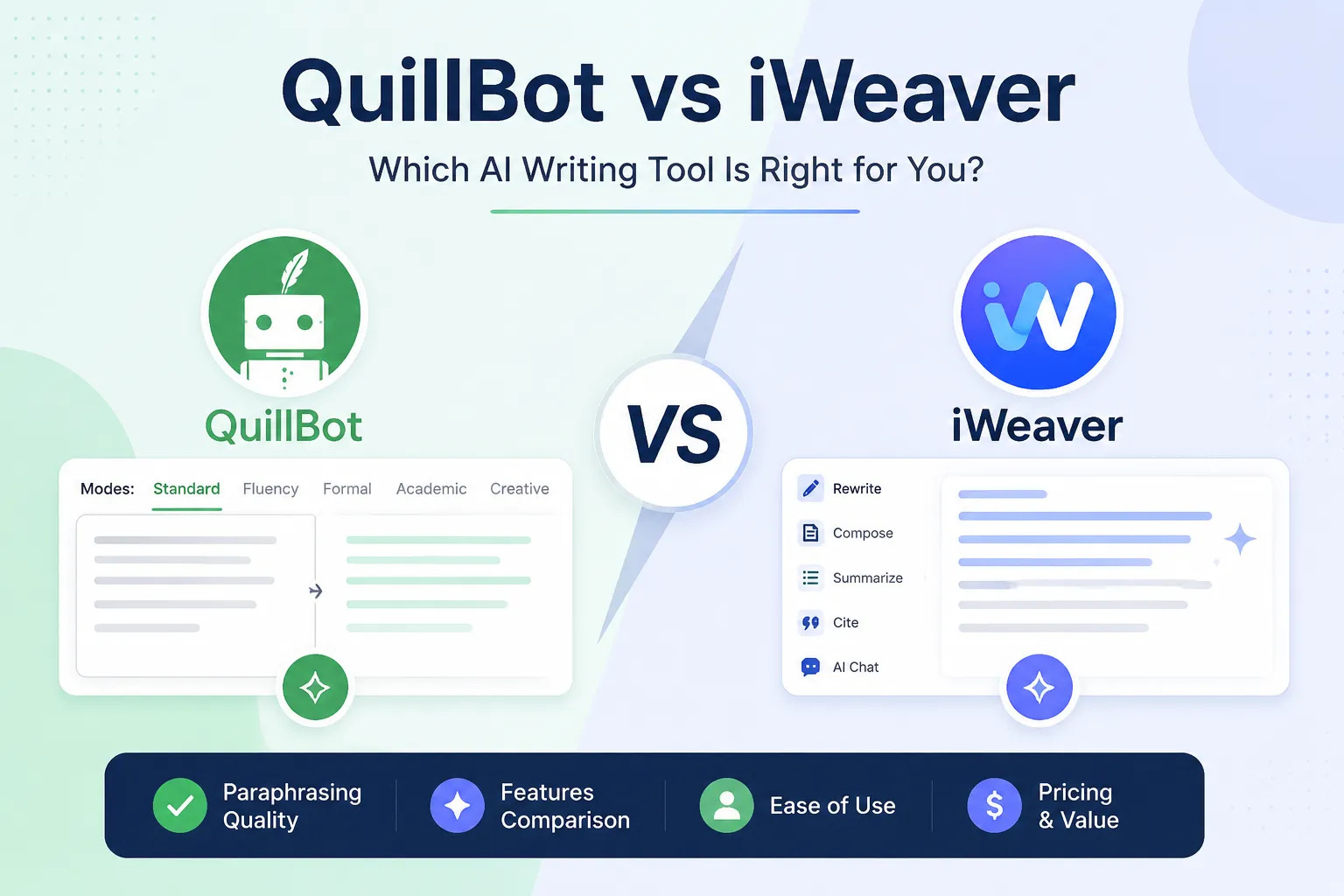
QuillBot and iWeaver both help users summarize information, but they are built for different jobs.
QuillBot is a focused writing and summarization tool. It is useful when you want to paste or upload text and quickly turn it into a shorter paragraph or bullet list. iWeaver is a broader AI knowledge workspace. It can summarize content too, but its stronger value is helping users process multiple formats, organize outputs, and turn summaries into reusable knowledge.
If you only need a fast summary of a passage, QuillBot may be enough. If your work involves PDFs, web pages, videos, transcripts, research notes, or recurring document workflows, iWeaver is likely the stronger choice.
Quick Comparison
| Dimension | QuillBot | iWeaver |
|---|---|---|
| Best for | Quick text summarization, paraphrasing, writing support | Multi-format summarization, notes, knowledge workflows |
| Summarizer modes | Paragraph and bullet point modes | Summaries, bullet points, structured notes, outlines, mind maps, workflow outputs |
| Input focus | Primarily text and document-style inputs | Text, PDFs, links, documents, videos, transcripts, images, and other formats depending on tool |
| Output depth | Concise summary output | Summary plus downstream organization and reuse |
| Knowledge base | Not the core product positioning | Central to iWeaver’s positioning |
| Ideal user | Students and writers who need quick condensation | Researchers, analysts, students, and professionals managing many sources |
Where QuillBot Has the Advantage
QuillBot is simple and direct. Its summarizer is built around a clear task: reduce longer text into a shorter version. According to QuillBot’s Help Center, its summarizer includes paragraph mode and bullet point mode. This makes it easy to choose between a more natural condensed paragraph and a scannable list of key ideas.
QuillBot also offers a Select Keywords feature that lets users highlight important terms or phrases to prioritize in the summary. This is useful for students, researchers, and professionals who need to make sure key names, concepts, or terminology are not lost.
QuillBot’s broader product family is also familiar to many writers because of its paraphrasing and grammar tools. For users who mostly work with essays, articles, emails, or short research excerpts, QuillBot is quick and low-friction.
Choose QuillBot if you want:
- A fast text summarizer.
- Simple paragraph or bullet summaries.
- A writing assistant with paraphrasing and grammar support.
- A lightweight tool for one-off summarization.
- A simple interface for students and writers.
Where iWeaver Has the Advantage
iWeaver is stronger when summarization is only one step in a larger workflow.
Many users do not simply need “a shorter version” of a text. They need to collect information from different sources, extract key points, compare materials, build notes, create outlines, generate mind maps, and keep the results for future use. That is where iWeaver’s workflow-oriented positioning matters.
iWeaver’s official pages describe tools for turning text, PDFs, videos, transcripts, URLs, and other materials into structured notes, summaries, outlines, and knowledge outputs. Its AI URL Summarizer page also highlights export options such as PDF, Word, Markdown, and plain text. This makes iWeaver more useful when summaries need to become part of a larger study, research, or reporting process.
Choose iWeaver if you want:
- Summarization across more input types.
- Structured notes rather than only condensed text.
- Workflow outputs such as outlines, mind maps, reports, or diagrams.
- A place to store and reuse knowledge.
- A better fit for multi-source research and professional document work.
Summarizer Quality vs Workflow Quality
QuillBot is competitive when the task is narrow: summarize this text. Its paragraph and bullet modes are easy to understand, and the keyword selection feature gives users some control over what the summary preserves.
iWeaver is competitive when the task is wider: process this material, organize it, and help me use it later. A user might summarize a web page, turn a PDF into notes, convert a video into an outline, generate a mind map, and keep those insights in a personal knowledge base.
The key question is not simply “Which tool summarizes better?” It is “What do you need the summary to become?”
Output Formats
Output format matters because summaries are often not the final destination. A student may need study notes. A consultant may need a client-ready outline. A content team may need a brief. A researcher may need a source synthesis.
QuillBot’s summarizer is strongest for readable text outputs: paragraph summaries and bullet point summaries. That is enough for many users.
iWeaver is better suited when the output needs to become:
- Structured notes.
- A study outline.
- A mind map.
- A research brief.
- A report draft.
- A reusable knowledge entry.
- An exported document such as Markdown, PDF, Word, or plain text depending on the specific iWeaver tool.
Practical Scenario: Student Research
A student reading one article for class may use QuillBot to quickly create a paragraph summary or bullet list. That is a good use case: fast, focused, and easy to review.
A student working on a thesis may need more than that. They may have PDFs, online articles, lecture videos, notes, and references. In that situation, iWeaver is a better fit because the task is not just summarizing one text; it is building structured knowledge across many materials.
Practical Scenario: Business Research
A marketer reviewing a competitor blog post may use QuillBot to condense the article into key points.
A marketing strategist comparing several competitor pages, customer interviews, PDFs, and meeting notes may benefit more from iWeaver. The output can become a structured research brief, content outline, or knowledge base entry rather than a standalone summary.
Which Should You Choose?
Choose QuillBot if your main need is quick text summarization and writing support. It is a strong option for students, writers, and professionals who want simple summaries without setting up a larger workspace.
Choose iWeaver if you need summarization as part of a broader knowledge workflow. It is better suited for users who work with many source types, need structured outputs, and want to keep information organized for future use.
QuillBot is a summarizer and writing assistant. iWeaver is a summarization-enabled knowledge workflow platform. The best choice depends on whether you need a quick condensed text or a system for turning information into structured, reusable work.
FAQ
Is iWeaver a QuillBot alternative?
Yes, for summarization and knowledge-work use cases. iWeaver can replace QuillBot when users need to summarize content and then organize the results into notes, outlines, mind maps, reports, or a knowledge base. QuillBot remains a strong choice for quick text summarization and paraphrasing.
Is QuillBot better for students?
QuillBot is useful for students who need quick summaries, paraphrasing, and writing support. iWeaver is better for students handling multiple sources, lecture videos, PDFs, and research notes that need to become structured study materials.
What summarization modes does QuillBot have?
QuillBot’s Help Center describes paragraph mode and bullet point mode. It also offers a Select Keywords feature to prioritize important terms in the summary.
What makes iWeaver different from a normal summarizer?
iWeaver focuses on the full workflow around information: multi-format input, summarization, structured notes, workflow outputs, and knowledge base reuse. It is designed for users who need to do something with summaries after generating them.