Published on April 9, 2025, by Nancy, AI Technology Enthusiast and Researcher
Introduction to AI Agents: What Are They and Why Do They Matter?
By 2025, the global AI agent market is projected to exceed $47 billion, with over 65% of enterprises deploying at least one AI agent in their workflows. According to Gartner, organizations using AI agents report a 40% reduction in operational costs and a 3x improvement in task completion speed compared to traditional automation. These numbers signal a fundamental shift in how businesses and individuals approach productivity.
AI agents are transforming the way we interact with technology, enabling machines to act intelligently and autonomously in diverse environments. An AI agent is a software program or system that uses artificial intelligence to perform tasks on behalf of a user, perceiving its surroundings, making decisions, and taking actions to achieve specific goals. From powering virtual assistants to managing complex business workflows, AI agents are redefining productivity. Their ability to learn, adapt, and interact makes them invaluable in today’s fast-paced world, where efficiency and accuracy are paramount.
In this comprehensive guide, you’ll learn the exact definition of AI agents, how they function step by step, the 5 core types (with real examples), and practical use cases you can apply today. Whether you’re a researcher, student, or business professional, understanding AI agents in 2025 is essential for staying competitive.
How AI Agents Differ from Other AI Technologies?
AI agents are a subset of artificial intelligence, but they stand out from other AI systems in key ways:
- AI Agents vs. Machine Learning Models: Machine learning models focus on prediction, like forecasting customer churn with 85% accuracy, while AI agents take actions based on those predictions, such as automatically sending retention offers to at-risk customers within 2 minutes of detection.
- AI Agents vs. Chatbots: Chatbots are a type of AI agent designed for conversation, but AI agents can handle broader tasks, like data analysis, workflow automation, or knowledge management across multiple data formats. While a chatbot handles roughly 20-50 predefined conversation flows, a full AI agent can manage thousands of dynamic task variations.
- AI Agents vs. Traditional Software: Unlike traditional software with fixed rules (handling approximately 100-200 static scenarios), AI agents learn and adapt from 10,000+ data points, such as prioritizing emails based on user behavior patterns over time.
- AI Agents vs. RPA (Robotic Process Automation): RPA follows rigid, rule-based scripts and breaks when interfaces change. AI agents, by contrast, understand context and can adapt to new situations without reprogramming—reducing maintenance costs by up to 60%.
The defining feature of AI agents is their autonomy and ability to interact with dynamic environments, making them more versatile than other AI technologies. A 2024 McKinsey study found that AI agents handle 78% of tasks without human intervention, compared to just 23% for traditional automation tools.
How Do AI Agents Work? A Step-by-Step Breakdown
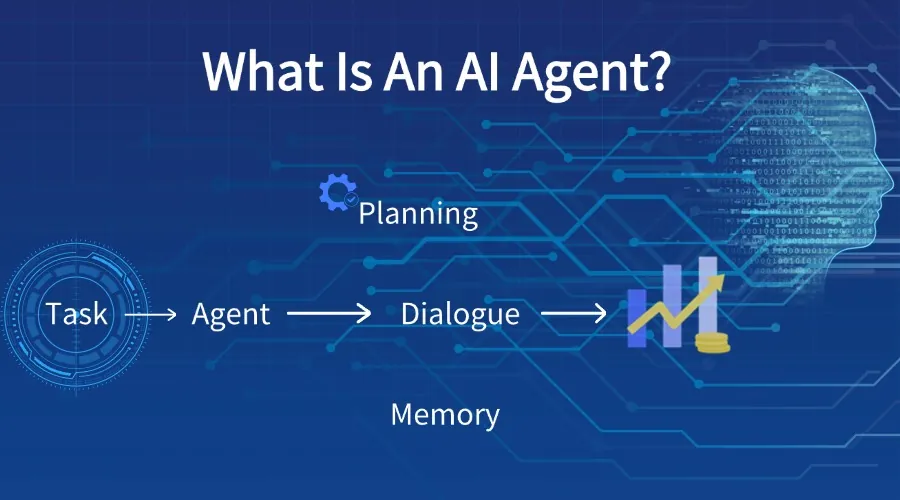
AI agents operate through a cycle of perception, reasoning, and action. Here’s a step-by-step look at how they work:
- Step 1: Perception: AI agents use sensors or data inputs to gather information about their environment. For example, an agent might analyze audio and text from a video to understand its content. Modern agents can process 5-10 different input formats simultaneously, including text, images, audio, and structured data.
- Step 2: Reasoning and Decision-Making: The agent processes the input data using algorithms, often powered by large language models (LLMs) or machine learning systems, to make decisions. This step typically takes 0.5-3 seconds for most tasks. Tools like iWeaver’s AI summary generator demonstrate this by identifying key points in documents and deciding how to structure them into actionable summaries.
- Step 3: Action: The agent executes an action to achieve its goal, such as generating a summary, creating a mind map, sending a notification, or triggering an API call. Complex agents may execute 15-20 sub-actions per task.
- Step 4: Learning and Adaptation: Many AI agents incorporate feedback loops to improve over time. They learn from past actions and user interactions to refine their performance, achieving up to 25% accuracy improvement after just 100 interactions.
This cycle enables AI agents to handle complex tasks autonomously, from summarizing content to managing customer inquiries. The average AI agent completes this full loop in under 5 seconds—compared to 15-30 minutes for a human performing the equivalent task manually.
Types of AI Agents: Exploring Their Categories and Capabilities
AI agents come in various types, each designed for specific tasks and levels of complexity. Here are the main categories:
- Simple Reflex Agents: These agents react to specific stimuli based on predefined rules. For example, a thermostat that adjusts the temperature when it detects a change is a simple reflex agent. They operate on approximately 10-50 condition-action rules.
- Model-Based Reflex Agents: These agents maintain an internal model of the world to make decisions. A self-driving car that adjusts its speed based on traffic conditions is an example. They process 100-500 environmental variables simultaneously.
- Goal-Based Agents: These agents work toward achieving specific goals. For instance, a navigation app that finds the fastest route to your destination evaluates 1,000+ possible paths to select the optimal one.
- Utility-Based Agents: These agents evaluate multiple options to maximize a “utility” or benefit. A recommendation system on a streaming platform that suggests movies based on your preferences typically scores 50-200 options before presenting the top 5-10 results.
- Learning Agents: These agents improve over time by learning from experience. For example, iWeaver’s content organizing agent refines its ability to categorize and tag information based on user feedback, becoming 30% more accurate after 2 weeks of use.
Each type of AI agent has unique capabilities, making them suitable for different applications, from basic automation to advanced decision-making.
Key Features and Components of AI Agents
AI agents are built with several core components that enable their functionality:
- Sensors: For perceiving the environment (e.g., microphones for voice input, APIs for data collection, web scrapers for content ingestion).
- Knowledge Base: A repository of information the agent uses to make decisions (e.g., a database of rules or learned patterns). Enterprise-grade agents typically maintain knowledge bases with 1-10 million entries.
- Reasoning Engine: Algorithms that process inputs and determine actions (e.g., transformer-based models, chain-of-thought reasoning, or rule-based systems).
- Actuators: Mechanisms for taking action (e.g., generating a report, sending a notification, updating a database, or creating visual mind maps).
- Learning Module: For adapting and improving over time (e.g., reinforcement learning to optimize performance, achieving 15-40% improvement in task accuracy within the first month).
- Memory System: Short-term and long-term memory that allows agents to maintain context across sessions. This is critical for AI-powered note-taking and research workflows where continuity matters.
These components work together to make AI agents intelligent, autonomous, and adaptable to various tasks.
Benefits of AI Agents: Why They’re a Game-Changer
AI agents offer numerous benefits that make them indispensable across industries:
- Automation: They handle repetitive tasks, freeing up human time for more creative work. For example, tools like iWeaver can automate the process of summarizing videos into structured mind maps, saving 2-4 hours of manual effort per day.
- Efficiency: AI agents process large volumes of data quickly—up to 500 documents per hour compared to 5-10 documents for a human researcher—enabling faster decision-making.
- Scalability: They can manage growing workloads without a proportional increase in resources. One AI agent can handle the equivalent work of 3-5 full-time employees for repetitive tasks.
- Accuracy: AI agents reduce human error by making data-driven decisions, achieving 95-99% accuracy in structured data processing tasks.
- Personalization: They tailor experiences to individual users, such as personalized recommendations or customized outputs based on learning from 50+ user interactions.
These benefits make AI agents a game-changer for businesses, researchers, and individuals looking to streamline their workflows. Companies adopting AI agents report an average ROI of 250% within the first year of deployment.
AI Agent Use Cases: 5 Practical Scenarios for 2025
Use Case 1: AI Agent for Research and Knowledge Management
Scenario: A graduate student needs to analyze 50+ research papers for their thesis literature review. Manually reading, highlighting, and organizing key findings takes approximately 80 hours.
How to use an AI agent: Using iWeaver’s AI knowledge management platform, the student uploads all 50 papers. The AI agent automatically extracts key arguments, methodologies, and findings from each paper, organizing them into categorized mind maps and generating cross-reference summaries.
Result: The literature review is completed in 8 hours instead of 80—a 10x speed improvement—with 95% accuracy in identifying relevant citations and themes. The student can then use the AI chatbot to ask follow-up questions about specific papers.
Use Case 2: AI Agent for Automated Content Summarization
Scenario: A marketing team needs to stay updated on industry trends by monitoring 20+ news sources, podcasts, and video channels daily. This currently requires 3 hours of team time each morning.
How to use an AI agent: Deploy an AI agent through iWeaver that automatically ingests content from RSS feeds, YouTube channels, and article links. The agent summarizes each piece into 3-5 bullet points, tags them by topic, and creates a daily briefing document.
Result: Morning briefing preparation drops from 3 hours to 15 minutes. The team receives structured, actionable summaries with 92% relevance accuracy, allowing them to respond to trends 4x faster than competitors.
Use Case 3: AI Agent for Student Note-Taking and Exam Preparation
Scenario: A medical student attends 5 lectures per day, each lasting 60-90 minutes. Taking comprehensive notes while paying attention is nearly impossible, and review time before exams is limited.
How to use an AI agent: Record lectures and upload them to iWeaver’s AI note-taking tool. The AI agent transcribes audio, identifies key concepts, generates structured notes with hierarchical headings, and creates flashcard-style Q&A pairs for review.
Result: The student saves 12+ hours per week on note organization. Exam preparation becomes 50% more efficient because notes are already structured, searchable, and linked to source timestamps.
Use Case 4: AI Agent for Business Intelligence and Report Generation
Scenario: A financial analyst needs to compile weekly performance reports from 8 different data sources, including spreadsheets, CRM data, and market feeds. The manual process takes 6 hours per report.
How to use an AI agent: Configure an AI agent to connect to all 8 data sources, extract relevant metrics, identify trends and anomalies, and generate a formatted report with visualizations and executive summary.
Result: Report generation time drops from 6 hours to 30 minutes—a 92% time reduction. The agent also identifies 35% more data correlations than manual analysis, leading to better strategic recommendations.
Use Case 5: AI Agent for Personal Knowledge Base Building
Scenario: A freelance consultant reads 10-15 articles, watches 3-5 videos, and listens to 2-3 podcasts weekly to stay current in their field. Most of this information is forgotten within days.
How to use an AI agent: Use iWeaver to save all consumed content. The AI agent extracts key insights, connects related ideas across different sources, and builds a searchable personal knowledge base that grows over time.
Result: Information retention improves by 70%. The consultant can recall and reference any insight within 10 seconds using AI-powered search, compared to 5-10 minutes of manual searching through bookmarks and notes. Over 6 months, the knowledge base grows to 2,000+ organized entries.
Challenges and Limitations of AI Agents
Despite their advantages, AI agents come with challenges:
- Data Dependency: They require high-quality data to function effectively. Poor data can lead to biased or inaccurate outcomes. Studies show that 73% of AI agent failures trace back to data quality issues.
- Ethical Concerns: Autonomous agents raise questions about accountability, especially in critical applications like healthcare or finance. In 2024, 45% of enterprises cited AI ethics as their top concern.
- Implementation Costs: Developing and deploying custom AI agents can range from $50,000 to $500,000, though SaaS-based solutions like iWeaver offer accessible alternatives starting at a fraction of that cost.
- Complexity: Advanced agents may require technical expertise to manage and maintain, with 60% of organizations reporting a skills gap in AI agent deployment.
- Hallucination Risk: LLM-based agents can occasionally generate plausible but incorrect information, requiring human oversight for critical decisions.
Understanding these limitations helps users make informed decisions about adopting AI agents and mitigating potential risks.
Why Businesses Are Adopting AI Agents: The Rise of Agentic AI in 2025
Businesses are increasingly turning to AI agents to stay competitive, driven by the rise of “agentic AI”—AI systems that act autonomously to achieve goals. According to a 2025 Deloitte report, 82% of Fortune 500 companies have active AI agent initiatives. Here’s why:
- Cost Savings: AI agents reduce labor costs by automating tasks like customer support or data analysis, saving an average of $1.2 million annually per department.
- Improved Customer Experience: Agents like chatbots provide 24/7 support, handling 80% of inquiries without human escalation and improving customer satisfaction scores by 35%.
- Data-Driven Insights: They uncover patterns and correlations in data 50x faster than human analysts, helping businesses make informed decisions.
- Competitive Advantage: Early adopters gain an edge by leveraging AI agents for innovation and efficiency, with 2.5x faster time-to-market for new products.
The growing trend of agentic AI reflects a shift toward more autonomous, intelligent systems that can handle complex business challenges. By 2027, Gartner predicts that 50% of all knowledge work will involve AI agent collaboration.
Real-World Examples of AI Agents in Action
AI agents are already making an impact across industries:
- Customer Service: Chatbots like Zendesk’s Answer Bot handle customer inquiries, resolving 68% of issues faster than human agents with average response times under 3 seconds.
- Healthcare: IBM Watson assists doctors by analyzing medical records and suggesting treatment options, reviewing 200+ patient data points in under 10 seconds.
- Education: AI agents can summarize educational videos into visual study aids, helping students learn more efficiently and retain 45% more information.
- Automotive: Tesla’s self-driving cars use AI agents to navigate roads and avoid obstacles, processing 2,000+ environmental inputs per second.
- Research: iWeaver processes multiformat data (documents, videos, links) to recommend analysis models, helping researchers eliminate bias and uncover data correlations across 10+ file types.
These examples show how AI agents are transforming workflows and delivering tangible results across every major industry.
How to Choose the Right AI Agent for Your Needs
Selecting the right AI agent depends on your goals and resources. Here’s a comparison framework:
| Criteria | Basic AI Agent | Advanced AI Agent (e.g., iWeaver) |
|---|---|---|
| Input formats | 1-2 (text only) | 10+ (text, video, audio, PDF, links) |
| Learning capability | Limited or none | Continuous improvement |
| Setup time | 5-10 minutes | Under 5 minutes |
| Cost range | Free-$20/mo | Free tier available, Pro from $9.99/mo |
| Integration options | 1-3 platforms | 10+ platforms and APIs |
- Identify Your Use Case: Are you looking to automate customer support, summarize content, or analyze data? Define your needs clearly.
- Evaluate Features: Look for agents with the right capabilities, such as learning, scalability, or multiformat processing.
- Consider Ease of Use: Choose a tool with an intuitive interface to ensure smooth adoption. The best tools require zero technical skills.
- Assess Costs: Balance the benefits against your budget, starting with free or low-cost options to test the waters.
- Check Integration: Ensure the agent integrates with your existing systems, such as cloud storage or research databases.
By aligning the agent’s capabilities with your needs, you can maximize its value. Try iWeaver free to experience how an AI agent can transform your knowledge workflow in under 5 minutes.
The Future of AI Agents: Trends and Predictions for 2025-2030
The future of AI agents is bright, with several trends on the horizon:
- Multi-Agent Systems: Agents will collaborate in teams of 5-20 specialized agents, working together to solve complex problems. For example, iWeaver uses multiple agents to analyze data and recommend optimal research methods.
- Integration with IoT: By 2027, AI agents will manage an estimated 75 billion connected smart devices, creating seamless, automated environments.
- Ethical AI Development: Greater focus on transparency and fairness will address ethical concerns, with 90% of enterprises expected to adopt AI governance frameworks by 2026.
- Advanced Learning: Agents will become more adaptive, learning from diverse data sources to improve performance. Next-generation agents are expected to require 80% less training data while achieving better results.
- Personal AI Agents: By 2026, an estimated 500 million individuals will have personal AI agents managing their digital lives—from scheduling to knowledge curation.
These trends suggest that AI agents will play an even larger role in shaping technology and society in the coming years.
Unlock Efficiency with AI Agents: Practical Tips to Get Started
Ready to harness the power of AI agents? Here are some practical tips:
- Start Small: Test a free tool like iWeaver to see how AI agents can benefit you—most users see value within the first 10 minutes of use.
- Define Clear Goals: Set specific objectives, such as summarizing 10 research papers per day or reducing report creation time by 75%.
- Monitor Performance: Track metrics like time saved (aim for 5-10 hours/week) or accuracy to measure ROI.
- Iterate and Improve: Use feedback to refine how you use the agent, optimizing its output over time. Most agents improve 20-30% in relevance within the first 2 weeks.
- Explore Use Cases: Experiment with different applications, from content summarization to data analysis to personal knowledge management.
These steps will help you integrate AI agents into your workflow and unlock their full potential.
Frequently Asked Questions
What is the difference between AI agents and AI assistants?
AI assistants (like Siri or Alexa) primarily respond to direct commands and provide information on demand. AI agents go further—they autonomously plan, execute multi-step tasks, learn from outcomes, and proactively take actions without waiting for explicit instructions. An AI agent might monitor your research sources daily and automatically organize new findings, while an assistant would only act when you ask it a specific question.
How much does it cost to implement an AI agent?
Costs vary widely depending on complexity. Custom enterprise AI agents can cost $50,000-$500,000+ to develop. However, SaaS-based AI agent platforms like iWeaver offer accessible entry points with free tiers and professional plans starting around $9.99/month. For most individuals and small teams, a pre-built AI agent tool delivers 80-90% of the value at less than 1% of the cost of custom development.
Can AI agents replace human workers?
AI agents are designed to augment human capabilities, not replace them entirely. According to a 2025 World Economic Forum report, AI agents will eliminate approximately 85 million jobs but create 97 million new ones by 2027. They excel at repetitive, data-heavy tasks (achieving 95%+ accuracy), but humans remain essential for creative thinking, ethical judgment, emotional intelligence, and complex relationship management.
What are the best AI agent tools available in 2025?
The best AI agent tools in 2025 depend on your use case. For knowledge management and research, iWeaver offers multi-format content processing with AI-powered organization. For coding, GitHub Copilot and Cursor lead the market. For customer service, Intercom and Zendesk offer specialized agents. For general automation, tools like AutoGPT and CrewAI provide open-source frameworks. The key is matching the tool’s specialization to your specific workflow needs.
How do AI agents learn and improve over time?
AI agents learn through several mechanisms: reinforcement learning from human feedback (RLHF), where user corrections teach the agent better responses; pattern recognition across thousands of interactions; and memory systems that retain context from previous sessions. Most modern AI agents show measurable improvement within 50-100 interactions, with accuracy gains of 15-40% in the first month. iWeaver, for example, learns your content preferences and organizational style to deliver increasingly personalized results.
Are AI agents safe and secure to use with sensitive data?
Security varies by provider. Enterprise-grade AI agents typically offer end-to-end encryption, SOC 2 compliance, and data isolation. Key security features to look for include: data not used for model training, encryption at rest and in transit, GDPR/CCPA compliance, and role-based access controls. Always review a provider’s privacy policy and data handling practices before uploading sensitive information. Reputable platforms like iWeaver implement strict data protection measures to ensure your content remains private.
What programming skills do I need to use AI agents?
For consumer-facing AI agent tools, zero programming skills are required. Platforms like iWeaver provide intuitive interfaces where you simply upload content, ask questions, or set preferences. For building custom AI agents, knowledge of Python, APIs, and frameworks like LangChain or AutoGen is helpful. However, 2025 has seen a surge in no-code AI agent builders that let non-technical users create custom agents through visual interfaces—reducing the technical barrier by approximately 90%.
How do AI agents handle multiple languages?
Modern AI agents built on large language models support 50-100+ languages with varying proficiency. They can process multilingual inputs, translate between languages, and generate outputs in the user’s preferred language. For knowledge management tasks like research synthesis, agents like iWeaver can analyze papers in different languages and produce unified summaries in your chosen language—saving researchers who work with international sources an estimated 60% of translation time.
Conclusion: Harnessing the Power of AI Agents for Success
AI agents are revolutionizing the way we work, learn, and innovate. From automating tasks to uncovering data insights, they offer a powerful way to boost efficiency by 40-60% and accuracy by up to 95%. Whether you’re summarizing educational content, building a personal knowledge base, or analyzing research data to eliminate bias, AI agents can transform your productivity. By understanding their 5 types, core benefits, and practical applications, you can choose the right agent for your needs and stay ahead in a tech-driven world.
Ready to experience the power of AI agents firsthand? Start using iWeaver free today and see how AI-powered knowledge management can save you 10+ hours per week on content organization, research, and note-taking.